
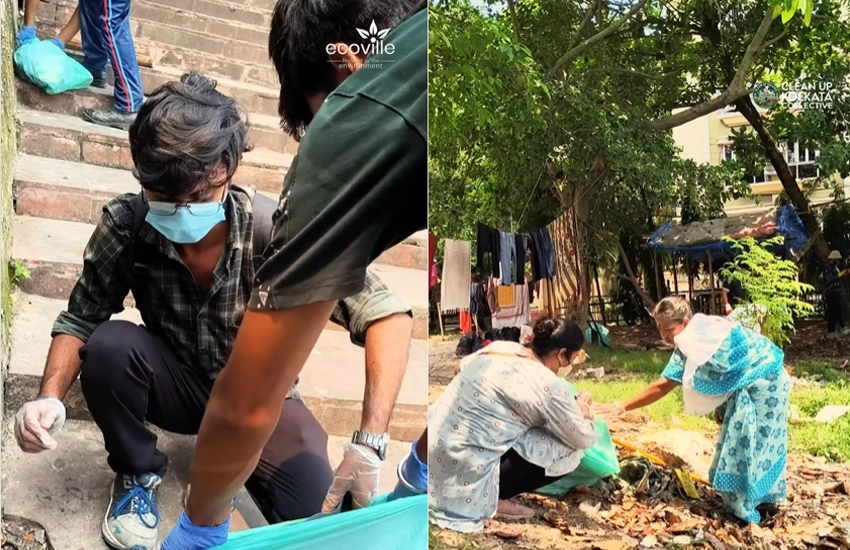
Ecoville X CleanUp Kolkata Collaboration
View this post on Instagram
Every year, environmental campaigns, awareness drives, and community initiatives remind us of the urgent need to address plastic pollution. Across cities, volunteers dedicate their time and energy to cleaning streets, rivers, ponds, and public spaces. Their efforts remove visible waste from the environment and inspire communities to take responsibility for the spaces they share.
Yet one important question often goes unasked: What happens to the waste after it is collected?
If plastic waste is simply transported from one location to another and eventually ends up in a landfill, the environmental problem is only shifted—not solved. Sustainable waste management requires a system that goes beyond collection and focuses on recovery, recycling, and reuse.
This belief is at the core of Ecoville’s approach to environmental stewardship.
Plastic pollution remains one of the most pressing environmental challenges of our time, particularly in urban water bodies where discarded materials can harm ecosystems, affect water quality, and disrupt local biodiversity.
While clean-up drives play a crucial role in restoring these spaces, their long-term impact depends on what follows after collection. Recognizing this, Ecoville partnered with Clean Up Kolkata Collective to ensure that recovered plastic waste would be directed into a circular economy rather than becoming another landfill burden.
On May 31st, volunteers at Bengal Lamp Pond in Jadavpur came together to remove plastic waste from the water body and its surrounding areas. A week later, on June 7th, a similar initiative was carried out at Nimtala Ghat, one of Kolkata’s most significant riverfront locations.
View this post on Instagram
View this post on Instagram
These efforts were about more than cleaning public spaces. They were about creating a pathway for waste to be transformed into a resource.
The plastic waste recovered through these clean-up drives was collected and transferred to Ecoville’s processing facilities, where it entered the recycling stream. Instead of being discarded, the material was given the opportunity to begin a new life cycle through responsible processing and resource recovery.
This process reflects a simple but powerful principle: waste should not be viewed as the end of a product’s journey. With the right infrastructure and partnerships, discarded materials can be transformed into valuable resources that re-enter the economy.
Building a circular economy requires more than technology alone. It requires collaboration between communities that recover waste and organizations capable of responsibly processing it. When these efforts come together, environmental action becomes both measurable and scalable.
The success of initiatives like the Bengal Lamp Pond and Nimtala Ghat clean-ups demonstrates what can be achieved when citizens, volunteers, and sustainability-focused businesses work toward a common goal.
Community-led clean-up drives help remove pollution from the environment. Recycling infrastructure ensures that the collected waste does not return as another environmental challenge. Together, they create a complete cycle of recovery and regeneration.
At Ecoville, we believe that environmental responsibility does not end when waste is collected. It begins there.
Our commitment is to ensure that plastic waste is not merely removed from sight but transformed into an opportunity for resource recovery and circular growth. Through collaborations like these, we continue working toward a future where waste is recognized not as a problem to be discarded, but as a resource to be reintegrated.
Because lasting environmental impact is created not only by cleaning our surroundings—but by ensuring that what we collect today becomes part of a more sustainable tomorrow.
