
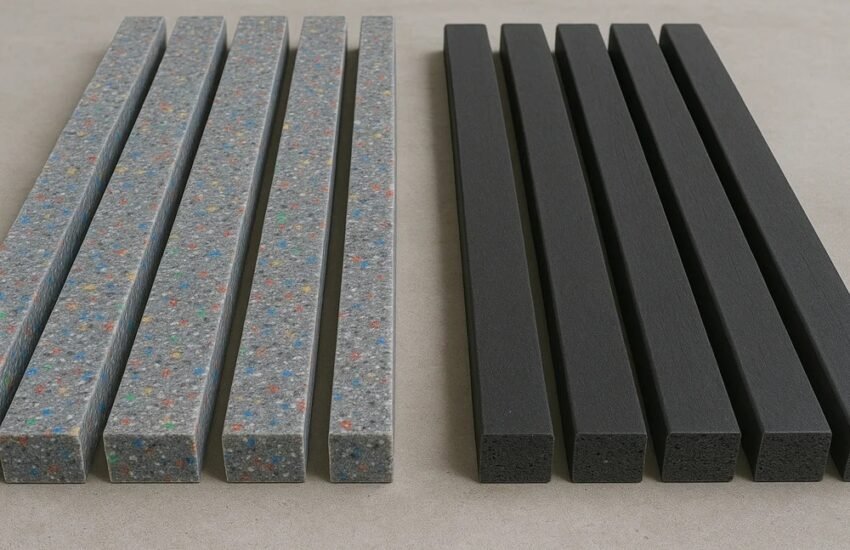
Recycled Plastic Lumber vs. Wood
Which Should You Choose?
A builder’s honest comparison of two very different materials and why one of them is made from what you threw away last week.
If you’ve been researching materials for a construction or renovation project, you’ve almost certainly come across the term recycled plastic lumber. It sounds promising. But it also sounds unfamiliar. Can plastic truly replace wood? Is it strong enough? How does it hold up in the long run?
At Ecoville, we manufacture recycled plastic lumber from post-consumer plastic waste — material that would otherwise end up in landfills or waterways. We think it’s the smarter material for the modern world. But rather than just saying that, let’s put both materials on the table and compare them honestly.
First, Let's Understand What We're Comparing
Traditional wood lumber is cut from trees — typically hardwoods or softwoods — and processed into planks, beams, and boards for construction, furniture, and structural use. It has been used for thousands of years and is familiar, workable, and widely available.
Recycled plastic lumber (RPL) is manufactured from reclaimed plastic waste — bottles, packaging, films, and other post-consumer plastics — which are sorted, cleaned, shredded, melted, and extruded or compressed into solid planks and profiles. The result looks and behaves very much like wood, but with a fundamentally different material profile.
Ecoville’s RPL is produced at our Plastic Recycling Plant (PRP), where collected plastic waste undergoes a carefully engineered four-stage process: preparation and sorting, processing and extrusion, compression, and final formation. The output is a dense, stable, homogenous material — consistent in ways that natural wood simply cannot be.
With the basics established, let’s compare the two directly across the properties that matter most to builders, architects, and buyers.
| Property | Traditional Wood | Ecoville Recycled Plastic Lumber |
|---|---|---|
| Termite resistance | Vulnerable — needs repeated chemical treatment | ✓ Inherently termite-proof |
| Moisture & water resistance | Warps, swells, rots over time | ✓ Fully waterproof — no absorption |
| Weather durability | Degrades under UV, rain & humidity | ✓ Weather-resistant for decades |
| Density & structural strength | Easy to cut, join & shape | ✓ Can be cut, drilled & moulded |
| End-of-life recyclability | Biodegrades or burns; limited recovery | ✓ 100% recyclable back into new products |
| Environmental cost | Drives deforestation & carbon loss | ✓ Converts waste; saves trees; cuts emissions |
| Lifecycle cost | Low upfront, high maintenance cost over time | ✓ Lower total cost of ownership |
| Material consistency | Natural variation in grain, knots, density | ✓ Engineered consistency in every unit |
Let's Talk About Termites
In India, termite damage is not a hypothetical concern — it’s a routine reality. Traditional wood structures, whether used in furniture, shuttering, door frames, or outdoor installations, require regular chemical treatment to resist termite infestation. Over time, these treatments need to be reapplied, adding cost and introducing chemicals into the living environment.
Recycled plastic lumber is inherently termite-proof. There is nothing in the material that termites find attractive. This isn’t a treatment or an additive — it’s a fundamental property of the material itself. For applications in humid, tropical climates like West Bengal, this is a significant advantage.
The Water Story
Wood and water have a complicated relationship. Moisture causes wood to swell, warp, crack, and eventually rot. Outdoor furniture, fencing, decking, and construction shuttering boards made from wood are in a constant battle with moisture — especially in a monsoon climate.
Plastic lumber does not absorb water. It won’t swell after a monsoon, won’t rot after years of exposure, and won’t compromise the structural integrity of what it’s used in. Ecoville’s shuttering boards, for instance, are specifically engineered to withstand the pressure, moisture, and repeated reuse cycles of construction sites — without the degradation that plywood and wood boards experience.
Density and Strength
One of the most common misconceptions about plastic lumber is that it must be weaker than wood. In fact, Ecoville’s recycled plastic lumber is denser and stronger than most common wood varieties used in construction and furniture. The extrusion and compression process produces a homogenous material with no voids, no knots, and no grain inconsistencies — all of which are potential failure points in natural wood.
This makes RPL particularly well-suited to load-bearing applications like storage pallets, benches, outdoor furniture frames, and structural profiles — applications where consistency under repeated stress is critical.
Frames exposed to humidity benefit enormously from a material that won’t swell, warp, or crack — keeping doors and windows functioning perfectly for years.
Where Recycled Plastic Lumber Excels
RPL is not trying to replace wood in every application — but there are categories where it is genuinely the superior choice:
Outdoor Furniture & Benches
Parks, gardens, school yards, and public spaces — anywhere exposed to rain, sun, and heavy use. No repainting, no rotting, no surprise structural failures.
Construction Shuttering
Concrete formwork demands a material that holds shape under pressure and moisture. Plastic shuttering boards outperform plywood in both durability and reusability.
Fencing & Barriers
Boundary fencing and site barriers require weather-proof, maintenance-free materials. RPL profiles deliver years of service without treatment or replacement.
School Furniture
Children's benches, tables, and swings need to survive intense daily use and periodic cleaning. Plastic lumber is hygienic, durable, and splinter-free.
Door & Window Frames
Frames exposed to humidity benefit enormously from a material that won't swell, warp, or crack — keeping doors and windows functioning perfectly for years.
Industrial Pallets
Storage and logistics demand pallets that won't splinter, absorb chemicals, or degrade under heavy loads. Plastic lumber pallets are the industrial-grade solution.
Where Wood Still Has a Role
Honesty matters here. Wood has qualities that RPL does not replicate — natural grain aesthetics, the warmth of organic material, and centuries of cultural familiarity in traditional furniture and heritage architecture. For interior decorative elements where a natural wood appearance is intentional and aesthetics are paramount, wood remains relevant.
But for structural, outdoor, and high-wear applications? The case for recycled plastic lumber is compelling, and getting stronger as the technology matures.
The Bigger Picture: What Your Material Choice Means
Every ton of plastic recycled into lumber is a ton that doesn’t end up in a landfill, a river, or the ocean. Every piece of RPL that replaces a wooden beam or plank is a tree that was not cut down. These aren’t abstract environmental claims — they are direct, measurable outcomes of the material choice you make.
India generates over 32 million metric tons of packaging waste every year. Ecoville exists to intercept that waste stream and give it a second life as something durable, useful, and valuable. When you choose recycled plastic lumber, you are participating in that circular economy — not as an act of sacrifice, but because the material genuinely performs better for most of the applications you need it for.
So, Which Should You Choose?
If your project involves outdoor exposure, a humid or tropical climate, high-wear use, or applications where maintenance should be minimised — choose Ecoville recycled plastic lumber. You will get a material that outperforms wood on durability, resistance, and total cost of ownership, while contributing directly to waste reduction and forest conservation.
If your project requires interior decorative woodwork where grain aesthetics are central to the design — wood still has its place. But even then, it’s worth asking whether a sustainable alternative might serve the function equally well.
The future of construction isn’t about choosing between performance and responsibility. With recycled plastic lumber, you get both.
