
Waste Management Infrastructure
What Is a Material Recovery Facility and Why Does It Matter?
Before plastic waste can become a bench, a door frame, or a storage pallet, it must pass through one of the most important and least talked about links in the recycling chain.
Most of us understand recycling in theory. Separate your waste, put it in the right bin, and it gets recycled. But what actually happens between the bin and the finished recycled product? The answer, in large part, is: a Material Recovery Facility.
At Ecoville, our entire manufacturing operation begins at the MRF. It is not a glamorous part of the story but it is the most important part. Without effective material recovery, there is no recycled plastic lumber, no sustainable building material, and no circular economy. There is just more waste.
This post is a clear, honest explanation of what an MRF is, how it works, what happens inside one, and why getting this step right determines whether recycling actually works.
The Problem We’re Solving
India generates an estimated 32 million metric tons of packaging waste every year, representing 12–15% of total Municipal Solid Waste (MSW). A large portion of this is plastic: bottles, films, packaging, bags, containers. The majority of it ends up in landfills, dumping grounds, or waterways.
Plastic, textiles, and other materials are separated and cleaned. Recyclable fractions are sent for processing. Resources re-enter the economy as new products.
The fundamental challenge of waste management is not collection — it is separation. When different types of waste are mixed together, they contaminate each other and become very difficult to recycle. A plastic bottle crushed alongside food waste or paper quickly becomes something no recycler wants to touch.
This is the problem that Material Recovery Facilities exist to solve.
So, What Exactly Is an MRF?
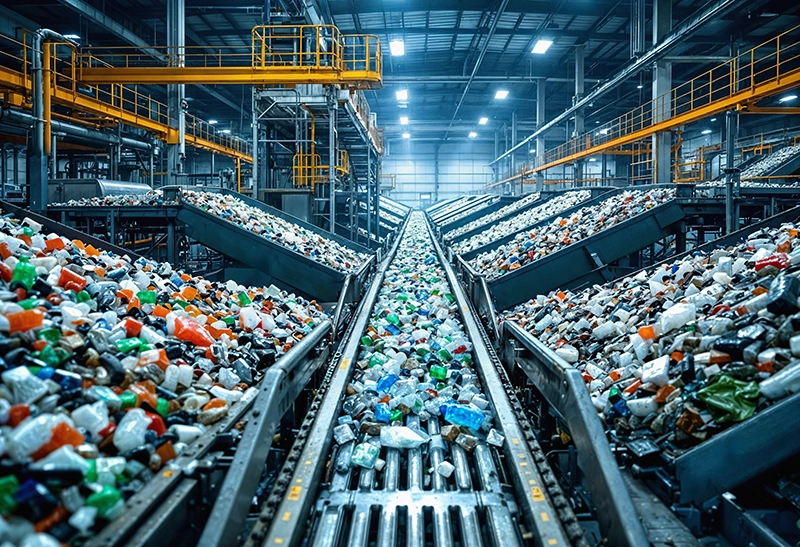
A Material Recovery Facility, commonly abbreviated as MRF, pronounced “murph” in the industry, is a specialised facility where collected solid waste is mechanically and manually sorted to separate out recyclable materials from non-recyclable waste.
Think of it as the triage centre of the recycling world. Waste arrives mixed and contaminated. It is separated into streams: plastics, metals, textiles, paper, and residual waste. Each stream then goes to the appropriate downstream processor, in Ecoville’s case, the plastic
fraction goes to our Plastic Recycling Plant (PRP), where it is transformed into construction materials.
The MRF is not the end of the story. It is, crucially, the beginning.
The Ecoville MRF operates in partnership with the Kolkata Municipal Corporation — collecting and diverting post-consumer waste from landfills at scale. It uses advanced sorting technologies to meticulously separate plastics, textiles, and other valuable materials, maximising resource recovery and minimising what ends up being discarded.
Inside an MRF: What Actually Happens?
The internal operations of a modern MRF involve a combination of mechanical systems and manual quality control. Here is how material moves through the facility:
- Intake and Initial Inspection: Collected waste arrives at the facility in trucks. The incoming load is weighed and visually inspected. Hazardous or obviously unsuitable material such as electronics, chemicals, medical waste is flagged and diverted before it enters the sorting line.
- Bag Breaking and Pre-Sorting: Waste is tipped onto conveyor belts. Bag-breaking equipment opens up collected bags so that material can be spread and inspected. Large, non-recyclable items (bulky waste, mattresses, large metals) are removed at this stage.
- Mechanical Separation: A series of mechanical systems separates materials by size, weight, and type. Trommels (rotating drum screens) separate fine organic material from larger items. Air classifiers blow lightweight plastics and papers off the belt. Magnetic separators pull ferrous metals. Eddy current separators remove non-ferrous metals like aluminium.
- Manual Sorting and Quality Control: Human sorters work alongside the mechanical systems, catching what machines miss and maintaining quality standards. They remove contaminants, separate plastic types (PET, HDPE, PP, LDPE), and ensure that each output stream meets the purity requirements of downstream processors.
- Cleaning and Preparation: Sorted plastics are cleaned to remove food residues, labels, and other contaminants. The cleanliness of the recovered material directly determines the quality of the final recycled product. This is not optional, it is what separates genuinely recycled material from waste that merely gets processed and landfilled anyway.
- Baling and Dispatch to the PRP: Clean, sorted plastic is compressed into bales for efficient transport and storage, then sent to the Plastic Recycling Plant, where the next chapter begins: transformation into Ecoville products.
The Link Between MRF and MRF EcoMeter
On the Ecoville website, you may have noticed the MRF EcoMeter, a live tracker that measures daily, monthly, annual, and lifetime totals of plastic waste processed through our facility. This is not a decorative feature. It is a direct accountability measure.
Every ton of waste that passes through the MRF represents plastic diverted from landfill. Every ton that moves on to the PRP becomes the raw material for an Ecoville product, a bench, a board, a pallet, a planter. The EcoMeter tracks that chain in real time.
We built this visibility into our public-facing presence because we believe accountability matters in sustainability. Claims about environmental impact are easy to make. Metered, traceable numbers are harder to manufacture.
Why MRF Quality Determines Recycled Product Quality
Here is a reality of recycling that is not often discussed: the quality of the output product is entirely dependent on the quality of the input material. If the plastic entering the recycling plant is contaminated, mixed with food waste, chemicals, non-plastic materials, or the wrong type of plastic, the resulting recycled material will be weak, inconsistent, or unusable.
This is why many “recycled” materials on the market are of disappointing quality. They were made from poorly sorted, poorly cleaned input streams. The MRF, done well, is what makes the difference between recycled material that is genuinely high-performance and recycled material that is simply green-washed.
Ecoville’s manufacturing process produces lumber that is denser and stronger than wood, with no pollution, no water effluent, and no solid waste. That outcome is only possible because the raw material feeding the PRP has been properly recovered and cleaned at the MRF stage.
In short: the quality of the MRF is the single biggest determinant of whether a circular economy actually works. Excellent sorting = excellent recycled material = excellent final product. Compromise at the MRF and you compromise everything downstream.
Why This Matters Beyond Ecoville
India’s plastic waste challenge is not going to be solved by individual consumers recycling more diligently, though that helps. It requires infrastructure, physical facilities staffed by trained workers, equipped with appropriate technology, integrated into municipal collection systems, and connected to genuine end-markets for recovered material.
The MRF is a critical node in that infrastructure. Without it, recyclable material mixes with general waste and cannot be recovered. With it, a city’s waste stream becomes a resource stream, feeding manufacturing plants that produce real, useful, durable products.
Ecoville’s MRF, operating in partnership with the Kolkata Municipal Corporation, is a working demonstration of what this looks like in practice. It is not a pilot or a concept. It is infrastructure. And it is turning the waste that Kolkata generates every day into the materials that will build Kolkata’s future.
From waste to worth: every Ecoville product, every bench in a park, every door frame in a building, every pallet in a warehouse began its life as post-consumer plastic, collected from the streets of Kolkata, processed through the MRF, and transformed at the PRP. The Material Recovery Facility is where that journey starts.
